
How to Start an Online Store: Complete Guide from Creation to Required Documents and Costs


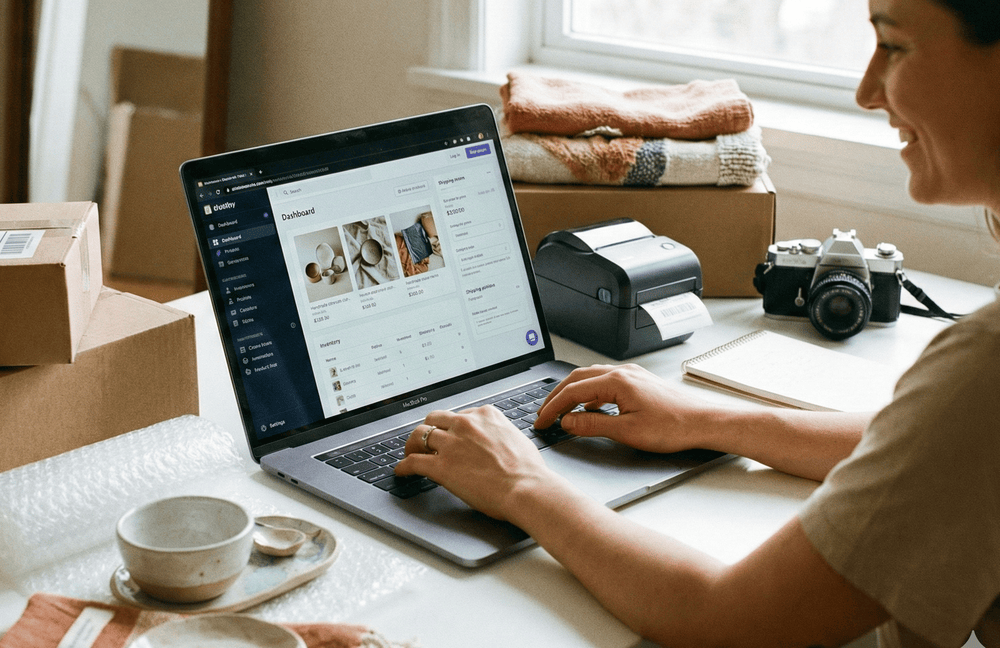
Are you thinking about launching an online store, but don't know where to start? That's normal: you have business decisions, technical decisions, and legal decisions to make, and if you mix them up, everything seems much more complicated than it is. The good news: if you follow a clear structure, you can quickly go from idea to your first online orders.
Before we dive into details, here's the map of this guide:
- Creating an online store: first steps (niche, budget, sales model)
- Business plan + Romanian ecommerce market analysis
- Documents required for an online store and legal framework
- How much does an online store cost: budget, initial investment, and monthly costs
- Where to buy merchandise for an online store: suppliers, wholesale, dropshipping
- How to create an online store: platform, development, SEO, security
- Ecommerce accounting + VAT + cash flow
- Online product delivery and logistics
- Online store promotion: SEO, Ads, social, email, influencers
Creating an online store - first steps for launching your business
Before the technical part, you need a minimum "skeleton" of decisions. If you skip it, you'll spend time and money on redoing things.
- Choose your niche: products with clear demand, decent margin, and a differentiator (quality, selection, delivery time, expertise).
- Define your model: own inventory, pre-orders, dropshipping, own production.
- Set your budget: initial investment + monthly costs for 6–12 months.
- Clarify operations: who handles customer support, packaging, invoicing, returns.
| Decision | Simple Question | Why It Matters |
|---|---|---|
Niche |
What problem do I solve and for whom? |
Defines your products, message, and marketing channels. |
Supply model |
Do I keep inventory or not? |
Influences your cashflow and delivery time. |
Budget |
How much can I sustain for 6–12 months? |
Determines your platform, promotion, and growth speed. |
Competitive advantage |
Why would they buy from me? |
Without a differentiator, you only compete on price. |
Once you've laid the foundation, the next step is a simple but realistic business plan to validate your decisions.
Business plan and Romanian ecommerce market analysis
A good business plan doesn't have to be a "drawer document." Its purpose is to clearly show you: how you sell, how much it costs, and when you become profitable.
Include at minimum:
- Target audience + problems + objections
- Direct/indirect competitors + your differentiator
- Pricing strategy + margins + variable costs
- Marketing plan (channels, budgets, KPIs)
- Financial projections: realistic + pessimistic scenario
Analyze the competition practically: look at reviews, delivery/returns, description quality, site speed, types of promotions. Often, the easiest "wins" come from better services, not price.
Documents required for an online store and legal aspects
Legal operation of an online store in Romania means two things: (1) a legal form (SRL/PFA etc.) and (2) compliance with legislation specific to online commerce.
SRL vs PFA: what to choose at the beginning?
For SRL (Limited Liability Company), the minimum share capital has been reduced in recent years to a symbolic level (in practice, you can start with 1 leu), but there are discussions and announced changes for increasing the minimum capital starting January 1, 2026 (for example, 500 lei for new companies), depending on the final form of the regulation.
For PFA (Authorized Natural Person), there is a limit of maximum 5 activities/CAEN classes that can be registered.
| Criterion | SRL | PFA |
|---|---|---|
Risk / liability |
Limited liability (generally) |
Personal liability (more exposed) |
CAEN codes |
Flexible |
Max. 5 |
B2B perception |
Usually more "corporate" |
Ok, but depends on industry |
Scaling |
Easier (team, investments, partners) |
More limited |
CAEN code for online commerce
For online commerce, use CAEN code 4791 (retail sale via mail order houses or via Internet) – and depending on products, you may also need additional codes.
Legal pages and obligations on the site
The relevant legal framework usually includes Law 365/2002 (electronic commerce), GEO 34/2014 (consumer rights), and GDPR (personal data). Practically, the following should be easy to find on the site:
- Company data (name, tax ID, headquarters, contact)
- Terms and conditions
- Privacy policy (GDPR) + cookies
- Delivery policy
- Return and warranty policy
How much does an online store cost - budget and initial investment
The question how much does an online store cost has two answers: launch cost and monthly operating cost. The difference between a store that "looks ok" and one that "sells" is usually in content + marketing + operations.
Setup costs depend on the legal form and services (accountant/consultant).
Domain and hosting have recurring costs (annual domain + monthly hosting, depending on needs).
Development can vary greatly: from subscription platforms to custom development.
| Category | What It Includes | Note |
|---|---|---|
Platform |
Shopify/WooCommerce/MerchantPro/other solution |
Choose based on budget + technical level. |
Design & content |
Branding, banners, product photos, descriptions |
Good content increases conversion. |
Inventory |
Initial merchandise |
Usually the largest investment (if not dropshipping). |
Monthly operation |
Accounting, maintenance, marketing |
Marketing is typically the major cost at the beginning. |
Reserve |
Unexpected expenses |
Keep 10–15% buffer for surprises. |
After budget, the next real "blocker" is supply: without good and predictable merchandise, you have no stability.
Where to buy merchandise for an online store - finding suppliers
For "where to buy merchandise for an online store" you have, in practice, 4 major options:
- Manufacturers (local or international) – better price, control, potential for exclusivity.
- Wholesale distributors – large variety, simplified supply, sometimes friendlier MOQ.
- B2B platforms – huge range, but you need serious verification (samples, certifications, deadlines).
- Dropshipping – start quickly, no inventory, but less control (delivery, packaging, returns).
| Model | Advantage | Biggest Risk |
|---|---|---|
Own inventory |
Fast delivery, total control |
Cash locked in inventory |
Pre-orders |
Test demand first |
Slower delivery, customer expectations |
Dropshipping |
Small investment |
Customer experience hard to control |
Own production |
Strong brand, better margins |
Capacity and consistency |
How to create an online store - choosing the platform and development
The process of how to create an online store starts with the platform. The simple rule: the faster you want to start, the more you need a "turnkey" solution.
| Platform | Suitable For | What to Verify |
|---|---|---|
WooCommerce |
Quick start + flexibility |
Hosting, plugins, maintenance |
Shopify/MerchantPro |
No technical headaches |
Monthly costs, custom limitations |
PrestaShop / Magento |
More complex stores |
Dev/maintenance costs |
Custom |
Very specific needs |
Budget + time + technical team |
Regardless of platform, there are some "mandatory" integrations for conversion:
- Online payments: online payment system (gateway + relevant methods)
- Courier (AWB generation + tracking)
- Analytics (GA4), Search Console, ads pixels
- Basic SEO: clean URLs, meta, speed, mobile
- Security: SSL, backup, updates
Ecommerce accounting and financial management
Good ecommerce accounting isn't just about "being ok with the tax authority," but showing you quickly if you're selling profitably. Keep track of:
- Gross margin by category
- CAC (customer acquisition cost) and LTV (lifetime value)
- Return rate and return cost
- Cashflow (difference between collections and payments to suppliers)
Pay attention to the VAT threshold: in 2025, there were announced/implemented changes regarding the increase of the exemption regime ceiling (from 300,000 lei to 395,000 lei), depending on the application timing and company situation.
Online product delivery and logistics
Online product delivery is one of the biggest sources of good or bad reviews. Don't treat it as an afterthought.
- Negotiate rates with 1–2 couriers (have redundancy).
- Offer clear options: locker, fast delivery, cash on delivery/card.
- Provide tracking + automatic notifications.
- Simple return policy (and easy to find).
Online store promotion and marketing
A good online store promotion strategy is one that brings you sales, not just traffic. Start with the minimum mix: SEO + ads + email.
| Channel | Role | When It's Most Effective |
|---|---|---|
|
Ecommerce SEO |
Stable organic traffic |
Medium-long term (3–6+ months) |
Google Ads |
Quick sales |
At launch and on "winner" products |
Social + UGC |
Brand + community |
When you have a visual product and story |
Email marketing |
High ROI, retention |
After you gather a minimum base |
On the payments side, it's worth having clarity from a cost perspective too: integrating a payment gateway solution and fees associated with collecting online payments directly influence your margin.
Referrals are usually among the cheapest sources of customers. Create simple mechanisms: discount code for friends, loyalty points, benefits for reviews with photos.
Frequently Asked Questions (FAQ)
1. How long does it take to launch a functional online store?
Typically, between 2–8 weeks, depending on complexity, content, and integrations.
2. Is it mandatory to have a company to sell online?
Yes, for legal sales you need a legal form (SRL/PFA etc.) and relevant CAEN codes.
3. How important is the online store design?
It's important for trust and conversion; a clear and fast design reduces friction in purchasing.
4. How do I choose the right platform for my store?
Choose based on: budget, technical level, number of products, integration needs, and scaling plan.
5. What payment methods should I offer customers?
Online card, cash on delivery, bank transfer. For conversion and trust, a good payment flow is important: payment gateway.
6. How do I manage returns and complaints?
You need a clear policy (including the legal withdrawal period) and a simple process for the customer.
7. How much budget should I allocate for marketing?
A common benchmark is 15–25% of turnover, and at the beginning, many businesses start with moderate monthly budgets and grow based on results.
8. How do I protect my store from cyber attacks?
SSL, updates, 2FA, backup, good hosting, password policies. And discipline.
9. Is it necessary to have physical inventory to sell online?
No. You can start with dropshipping or pre-orders, but you'll have less control over the experience.
10. How do I measure the success of my online store?
Conversion rate, AOV, CAC, LTV, return rate, organic traffic percentage, and recurring customers.
Next Steps for Your Online Success
If you want to start quickly and well, keep focus on three things: clear offer, frictionless operations, and measurable marketing. Review monthly the costs, conversion, and channels that bring real sales. And above all, continuously optimize the customer experience: delivery, support, returns, communication. That's where the long-term difference is made.